Gan Nora Rhiannon ac An Cú
CHAPTER 1: STATE THE OBVIOUS
On 1 June 2026, the Communist Party of Britain (CPB) released a statement across their various social media pages calling for “LGBT Liberation not Rainbow Capitalism.” In their statement, the party noted the various struggles of the early Pride movement and the oppression and persecution LGBTQ+ activists have faced since the Queer Liberation movement began to develop in the 20th century. The party also (as they traditionally do regarding a number of topics) called for communists to resist “Liberal identity politics” when addressing the issues facing LGBTQ+ communities in Britain today, positioning themselves as champions of LGBTQ+ liberation and queer workers against a rainbow capitalism that aims to represent certain segments of the LGBTQ+ population rather than liberate all of them together.
In principle this is absolutely the correct stance to take. Companies like Barclays, BAE, and BP use Pride events and rainbow branding to launder their reputations, presenting themselves as progressive champions of the LGBTQ+ community as a way to dodge and neutralise criticism. This process of Pinkwashing is ubiquitous, deployed by corporations, police forces and politicians alike. For many businesses Pride month has become an opportunity for “seasonal” marketing in the same vein as Christmas or Easter, with superficially LGBTQ+ themed merchandise that sells well and makes their brand look trendy and modern. Pride floats celebrating the presence of LGBTQ+ people in finance, policing and arms manufacturing jobs can be found at most pride events, though their presence is generally extremely controversial. Countries too get in on the action. The zionist entity also engages in pinkwashing, promoting hasbara that positions it as a promised land for the LGBTQ+ community (notably israel does not fully recognise gay marriage nor interracial marriage), despite the fact that the occupation forces routinely blackmail queer Palestinians to work as informants and of course have killed huge numbers of queer Palestinians in their genocidal campaign against the people of Gaza1. As we can see, pinkwashing and rainbow capitalism are alive and well across the imperialist world.
Given all this, what could be our issue with the CPB’s statement? Isn’t it correct to resist all attempts at pinkwashing capitalism and imperialism, and to promote the idea that only socialism will liberate LGBTQ+ workers? Let us examine the context that this statement exists within to understand the ways it rings hollow and fails to meet the political moment we are living through.
CHAPTER 2: THE SUPREME COURT DEBACLE
A little over a week ago the Equalities and Human Rights Commission (EHRC) released guidance that in practical terms constitutes an attempt to segregate trans people out of public life. This follows a UK Supreme Court decision, one that the CPB vocally supported, which ruled that under the Equality Act (2010) “sex” refers to an individual’s “biological sex”2. The guidance itself expanded on ruling from by stating that single-sex spaces, such as toilets and changing rooms, must be used on the basis of an individual’s “biological sex”. Official guidance now is that trans people should use facilities ranging from toilets and changing rooms to hospitals and prisons based on their assigned sex at birth, rather than based on what makes sense for them in the here-and-now.
This is a direct attack on the right of trans people to exist as full members of society and go about their daily lives in peace. Demanding that trans people use bathrooms and changing rooms they feel they do not belong in is not only humiliating in itself but will also expose them to harassment. The guidance provides a framework through which transphobes, by reporting their “discomfort” with sharing a public space with a trans person, can effectively deputise retail workers as gender police and demand their victim’s removal. Service providers, should they so wish, will now be able to discriminate against transgender people and deny them access to gendered facilities so long as they provide gender neutral ones instead, effectively segregating trans people from the rest of society. Though the guidance does not cover workplaces, it provides a precedent that could be used in the future by employers to discriminate against employees by forcing trans people to use separate toilets and changing rooms at work. Employers may also use the guidance as justification to sack any trans employee they deem to be acting “difficult” about its implementation. This could have a seriously negative impact on trans people finding work, as well as impacting the working conditions, wages and job security of trans people. This is especially alarming considering how high the unemployment rate in the trans community is already3. As Alexandra Parma-Yee has pointed out, the government has even acknowledged that this new guidance will harm trans women, trans men, gender non-conforming cis women and disabled people, and is ultimately likely to lead to higher rates of assault and harassment any time trans people attempt to use a toilet or changing room in public4. To illustrate the significance of the new EHRC interpretation of the law, trans men and women can now be “fairly” denied access to rape crisis services and domestic violence shelters. Trans women are already being forced into men’s prisons, which puts them at an extremely high risk of sexual and physical violence5.
The Labour Party has effectively introduced this generation’s version of Section 28 legislation against trans people, which is aimed at harassing them out of public existence at the behest of various transphobic lobby groups financed by various American far right reactionaries.
At a time where trans people are facing such a massive crackdown on their civil liberties and their rights as workers, we point again to the notable absence of any mention of the updated EHRC guidance by the CPB in their Pride Month statement. This is especially jarring considering the updated guidance was released only last week and has earned condemnation not just from various transgender liberation groups, but also from a number of socialist and communist parties.
CHAPTER 3: SMUGLY FAILING TO UNDERSTAND THE ISSUE
The reason for this is that the CPB has previously welcomed the push towards excluding trans people from public life. Since 2018 the CPB has gradually been moving towards a policy of defending women’s “sex-based rights” and taking the position that women’s oppression stems from their “biological sex” and “gender stereotyping”6. In 2025 the party issued a statement alongside its youth wing praising the Supreme Court’s ruling that sex in the Equality Act referred to “biological sex”7, and as recently as November 2025 the party affirmed their position supporting the Supreme Court at their 58th party congress, with outgoing General Secretary Rob Griffiths claiming that Green Party leader Zack Polanski had failed to defend the “sex-based rights” of women8.
The CPB argument rests on the idea that allowing trans people to use the “single-sex” services that correspond with who they are is a “negation” or violation of women’s “single sex rights”. They have made no attempt to prove this publicly, but rely on the assumption that it is self-evidently correct. They seek to win the argument not by examining the experiences of trans people (nor the experiences of many cis women!) and how they relate to broader society, but by positioning themselves as the arbiters of a “common sense” that is so obvious to us all that it doesn’t warrant any further investigation. The question we ask is this: what problems have trans women’s access to women’s spaces (which they have been using for decades now) actually caused for cis women? How is the presence of the former a violation of the rights of the latter? This is not explained by the CPB, save for the unspoken assumption that trans women are men. This is what passes for “materialist analysis” in the CPB, but as we will detail later in this article it bears little relation to the facts.
Another thing that stands out about the 2025 party statement is the patronising way that it papers over the concerns of trans people. It “reject[s] any notion that the Supreme Court ruling was influenced by, or issued as a result of, a transphobic political climate”, citing the statement of a presiding judge that it is not a “victory of one side over another”. That one side celebrates it as a victory and one side sees it as a defeat is treated as irrelevant. The overwhelmingly negative reaction of trans people to the potential loss of rights they face is spoken of as “misrepresentations of the ruling causing anxiety and division”. It interests us that the CPB can simultaneously insist that trans women are not women and also accuse them of hysterically shrieking about something they don’t really understand. Misogyny and transphobia walk hand-in-hand as usual. The CPB reassures us that they remain committed to “improve[d] resourcing” for trans “health and welfare services”, but how can such improvements be delivered at the same time as guidance which segregates trans people into designated third spaces. Wes Streeting has indicated a desire to create separate trans-only wards, but how is that possible in an NHS that is already shoving patients into corridors? In practice the CPB’s proposal here is that the government should improve trans people’s access to healthcare and welfare but restrict their access to “employment, education facilities, sports… etc.” This is not a serious or coherent position.
The supposedly iron-clad definition of “biological” legal sex that the party has tirelessly fought to defend is not as long-standing and unchanging as they make it out to be. “Legal sex”, now rebranded as “biological sex” by the Supreme Court, is actually a relatively recent phenomenon in British society, emerging from the 1970 Corbett vs Corbett ruling9. Rather than being a natural category that transgender people are seeking to overturn, it is itself a reaction to the “problem” of the increasing presence of trans people in British society.
CHAPTER 4: LANGUAGE LESSON
This increasingly vehement anti-trans position in the name of “defending a materialist conception of women’s oppression under capitalism” originates in a persistent anti-intellectual current within the theoretical organs of the CPB and its youth wing. Let us take a Challenge Magazine article as an example of the idealism at the core of this “sex-based” idea of “materialism”. In it, the author claims that “before the interventions of bourgeois feminism, gender was only used to refer to French and Spanish nouns, so the entire evolution of the term beyond that feels bourgeois”. This passes for a sufficient analysis of Second Wave Feminism for the magazine’s editors!
It does not really need to be stated that whether something “feels bourgeois” is meaningless. The degree to which an idea is bourgeois must be reasoned out by analysing its class content in detail, not by divining its “vibes” based on our pre-existing prejudices. Additionally “Before the interventions of bourgeois feminism” many medieval people believed that men and women had a physiological difference in the balance of their “humours” that made men more resistant to disease. Just because an idea happened to develop after bourgeois feminism did does not mean that there is a causal link between the two, or that if there is then the idea is the sole creation of bourgeois feminism and to be totally rejected. After all, we must remember that working-class feminism came on the heels of bourgeois feminism. But anti-trans ideologues are not interested in exploring the class basis of popular ideas about sex and gender, they are seeking excuses to call transgender people privileged and exclude them from working class politics. The author also dismissively tells us that the “bourgeois feminist” Simone de Beauvoir believed that gender was “social stereotypes of masculinity and femininity”, missing the Second Sex’s crucial point that “biological” sex is just as socially constructed as gender.
As self-proclaimed Marxists the CPB should be able to recognise that how we understand scientific facts cannot be divorced from a class context, and anything claimed to be “biological human nature” should be examined with great scrutiny. Indeed their insistence on a simplistic and binaristic understanding of sex relations is perhaps a hallmark of the CPB’s eurocentric and anti-intellectual attitude. Any cursory look at world history shows that many societies have had complex sex/gender systems10.
If we want to understand how sex relations work in our own capitalist society we need to examine how men and women, cis and trans, relate to production. To borrow from E. P. Thompson, class can only be observed as a relationship in motion between different groups mediated by the productive relations people are either born into or enter into voluntarily and involuntarily11. Just as it is insufficient to study class through a series of static and binary relations, so too is it insufficient to study the root causes of women’s oppression and patriarchy from the fixed standpoint of individual biology. A trans woman and a cis woman on average will be paid less than their male counterparts in similar industries, but it is only through analysing what the role of capital-w “Woman” is under capitalist society and how that identity is shaped and changed by the productive relations surrounding them that we can address the root causes of women’s oppression. If we were to accept the idea that trans women and cis women were fundamentally different from one another on the basis of their sexual organs, we would still need to explain how trans women, like cis women, experience similar phenomena like the gender pay gap, high rates of street harassment and physical, emotional and sexual abuse, medical neglect (etc.)12. It seems to us that a more comprehensive analysis regarding these shared oppressions is that they originate from how women as a social group (i.e., a gender individuals are identified as belonging to) are oppressed under capitalism, as opposed to the idea that cis women and trans women are oppressed in similar but fundamentally different ways. We would be very interested (or rather repulsed) to see a CPB cadre explain to a trans woman facing street harassment or pay disparity to her male coworkers that her grievances are fundamentally different to those of a “real woman” because of the body she was born with. To do so would ironically fall foul of the “gendered souls” fallacy that transphobes love to accuse the trans community of committing by claiming that there is some inherent, ineffable male quality to trans women that they retain regardless of how their bodies or social roles change.
CHAPTER 5: THE COMMUNIST PARTY OF BRITAIN AND THE CHAMBER OF ROWLING
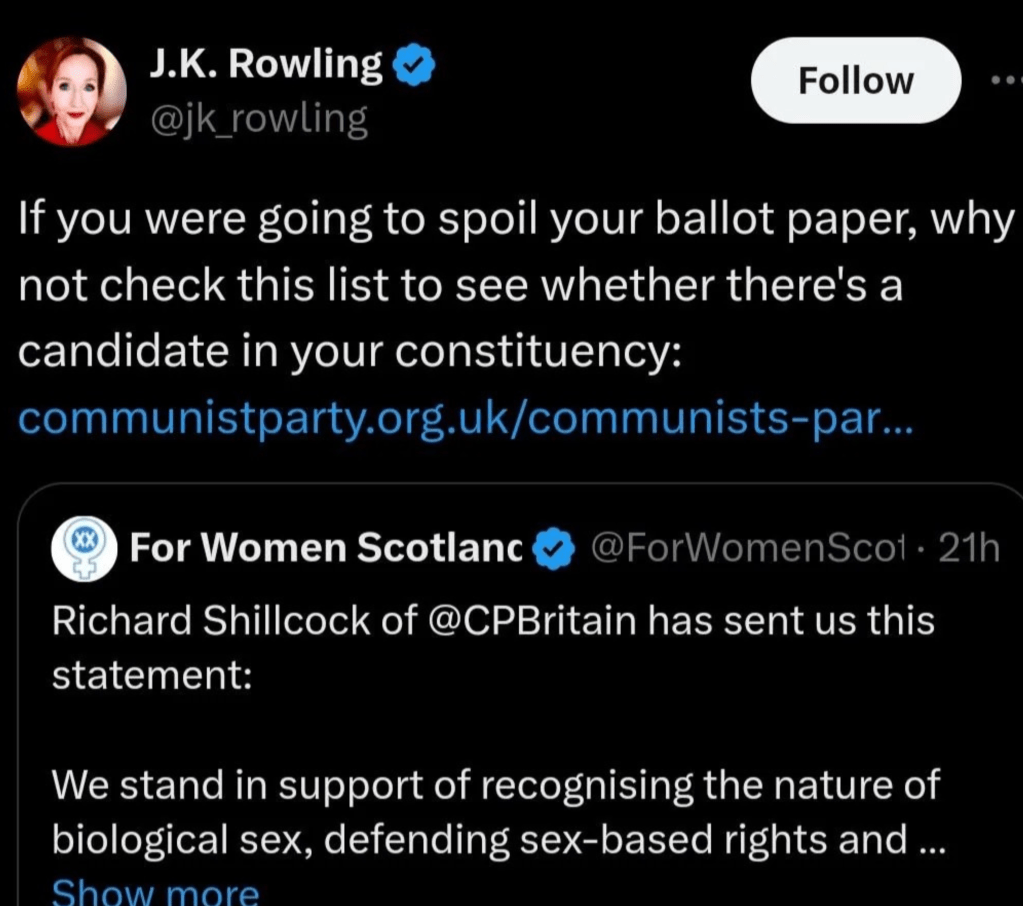
In the 2024 General Election the party received praise from billionaire and children’s author J. K. Rowling after their candidate for Edinburgh North and Leith issued a statement stating that the party wished to base sex in the Equality Act on an individual’s biological sex. The CPB candidate also sent a statement to For Women Scotland (a major transphobic lobby group) stating that the party opposed “gender ideology”, “gender affirming care” and would not support including anti-trans conversion therapy in a conversion therapy ban. One day later at 11:50pm, the official CPB twitter account issued a hasty clarification on their candidate’s support for trans conversion therapy, stating that they “support banning regressive conversion therapy targeting trans people.” Following an endorsement by both a billionaire and a transphobic lobby group, the CPB candidate received an astonishing 189 votes, coming second to last just behind the Scottish Family Party, clearly demonstrating the CPB’s ability to tap into the dissident energies and feelings of the Scottish working class.
This debacle is unsurprising given the position that the CPB holds on the wider British far left. Contrary to their claim that they represent the whole working class, the CPB has a stagnating, largely inactive membership mainly made up of remnants from the Corbyn movement in the aftermath of the 2019 disaster13. Trade union bureaucrats, retired academics, Morning Star journalists, left-wing NGO leaders: these are the sources from which the CPB draws its understanding of modern political developments. This is also a social circle that has become riddled with transphobia thanks to a steady diet of Guardian, Spiked, UnHerd and Novara Media “think-pieces”. They mostly fail to grasp that their obsession with the manufactured “transgender issue” is not one shared by the vast majority of working-class people. If there is to be a vanguard of the working class, trans women will undoubtedly be within it owing to their position as a highly oppressed and marginalised community of people who are able to directly identify the structures of their oppression. Meanwhile, the CPB has spent the last eight or so years articulating and defending the same legal and political structures that oppress trans women and pal-ing around with transphobic hate groups like Women’s Place.
CHAPTER 6: IGNORE THE ISSUE UNTIL IT GOES AWAY
Given the CPB’s endorsement of the Supreme Court ruling that forms the foundation of this new guidance, as well as their wider passion for transphobia, one would expect another party statement praising the EHRC’s position. This has yet to materialise. What reason can they have for such a glaring omission? Since they have published a boilerplate social media post to celebrate Pride month, we can eliminate the possibility that the CPB have simply forgotten that the LGBTQ+ community exists. Therefore we must search for other explanations.
When re-affirming their position on “sex-based rights” some members of the party recognised that it would hamper their efforts to recruit young people. This goes some way to explaining why the CPB is so shy about the guidance that’s been put forward. The CPB’s youth wing the Young Communist League (YCL) has already been haemorrhaging members, with splits such as the Red Wessex faction, and it seems like they’ve realised that speaking up now will only exacerbate that problem14. The party leadership clearly come from an “ignore the problem until it goes away” school of thought, and so they have tried to dodge the issue by releasing a Pride statement that is almost identical to the one they issued last year.
What does the “LGBT Liberation” they speak of actually mean to the CPB? They claim to oppose prejudice and discrimination, but gleefully uphold the “sex-based rights” framework under which the bourgeois state in Britain is constructing a legal regime designed to excise the trans community from public life. The CPB is unable to delve into the forces at play in British society that oppress trans people precisely because they have wedded themselves to this position of supporting “sex based rights”. All they are able to say is that capitalism perpetuates “divide-and-rule” (true) and that workers should “unite” (also true), but this is not a concrete proposal for action but rather mere sloganeering. What position should the newly united workers take on the “cultural” issues that divide them? Who should change their attitudes to facilitate this union, and in what way?
Because it lacks any grounding in the specifics of the modern LGBTQ+ struggle, this statement takes on a highly smug and disapproving character which drips from every word. It is rich for a party like the CPB, which continues to tail behind the Labour Party and attempt to launder its views to the most reactionary elements of British society regarding trans people or immigrants (i.e., people facing the some of the highest rates of economic exploitation and political and social marginalisation), to offer any guidance on how to engage with the issues facing LGBTQ+ people today. Its condemnation of “identity politics” detached from the “real struggle” of working people is totally unearned: firstly because it offers no guidance on how to address the unique issues LGBTQ+ workers face (aside from putting the “culture war” aside to focus on “uniting” with other workers) and secondly because the party is itself disconnected from the masses. The CPB functions as little more than a think tank for the Labour Left (a force that functionally ceased to exist six years ago) and certain elements of British trade union leadership as it is fundamentally unable to be a mass workers party, owing to its total unwillingness to actually intervene in society and face public debate and criticism for its positions. If some reports about the party’s 58th congress are to be believed, even the attempt to have an open debate about the party’s position on trans people was actively suppressed in favour of the “sex based rights” position favoured by a small clique in the party’s leadership15. When internal democratic processes and debates are not permitted even at the highest level of party democracy, it seems to us that, far from trying to build the mass workers party, the CPB is in fact acting like all the other various sects that it denounces.
At a time when the working class is clearly in disagreement on LGBTQ+ issues, principled Marxists should be finding the progressive position and working to convince workers of its correctness. Genuine working-class unity cannot be a mere cessation of hostilities, it has to find its basis in a shared ideology and shared understanding of the path forward. In our current situation of a class split into “cultural” camps, chasing the “popular” position inevitably leads to a position that is inherently contradictory. As tailists the CPB must be two things at once: they must be pro-LGBTQ+ to attract young progressives, and they must be anti-LGBTQ+ to attract older, more conservative sections of the working class. This is the origin of their nebulous “LGBT Liberation not Rainbow Capitalism” position. Ironically by using LGBTQ+ language and symbology they do not fully understand or agree with to advertise their party, the CPB actually mirrors the “Rainbow Capitalist” position they claim to criticise.
The party’s criticisms might also have a bit more weight to them if they were as critical of the British trade union movement as they are the modern Pride movement. Despite the correct denunciations regarding the British state’s remilitarisation and warmongering, little ink has been spilled by the party in pointing out that trade unions like Unite have successfully lobbied the government for further investment in British defence industries, which act as essential building blocks to maintaining British imperialism16. Whilst hundreds of words are spent on denouncing “identity politics” in relation to LGBTQ+ people in Britain (which are often kept vague and ill-defined but are largely demands for conformity based on the whims of a small clique), nothing is said about the complicity of trade union leadership in maintaining British imperialism and integrating organs of the working class into the machinery of the capitalist-imperialist state.
The deep fear of alienating the “real” working class that keeps the CPB leadership and cadre silent on some issues and vocal on others is based in not only a misunderstanding of what the working class is like, but also a misunderstanding of working class politics. Bold insistence on investigation and analysis, on “ruthless criticism of all that exists”, on speaking the unvarnished truth is the core appeal of Marxism as a political method. The day you refrain from making criticism for cowardly, unprincipled reasons is the day you cease to be a Marxist and become a liberal. This inability for the party to rectify its errors and correct course stems from the persistent anti-intellectualism that is rife within it. Fields of study like Marxist-feminism are dismissed in small paragraphs as unscientific idealism hawked by “emotional” academics divorced from the real struggles of the working class, which to the CPB is an unthinking and unchanging ideological-cultural monolith whose every bigotry must be catered to lest communists alienate their support base of 200 or so voters per constituency at every local or national election17.
To an entire generation of young, principled communists who are against the mainstreaming of transphobia in society, the CPB is not only disgusting but increasingly irrelevant. It is, of course, not really the done thing (as it is in places like the US) for Marxists in Britain to openly attack Communist parties they believe to be opportunist and tailist. But when Marx said “ruthless criticism of all that exists” he meant not just to the structures of capitalist society but also the supposedly radical groups who uphold and proliferate those same structures in their thoughts and actions. By condemning the party’s incoherent and insulting position our main interest is not really in seeking to dissuade people from joining it (it is doing that already without our help), but in warning the communists of today and of the future about the dangers of a tailist strategy. The CPB’s blatant opportunism on issues where it thinks it will benefit them electorally and their dogmatic misunderstanding (or outright ignorance) of issues facing the modern working class have all been core features of the party arguably since it began following its so-called “British Road to Socialism” in 1951. In this respect, the party provides us a very valuable lesson in the ways in which a communist party can be mismanaged and fall into tailing the most reactionary elements of society rather than aligning with the more revolutionary elements. We are thankful to the CPB for illustrating this to us.
Transphobia and homophobia are social poisons that do not originate from thin air, but rather from the proliferation of a bourgeois gender ideology that places men in positions of power and women in positions of dependence and exploitation, and violently sanctions anyone who deviates from these gender norms. We need a party that does not just kick the question of LGBTQ+ liberation down the road, but actively seeks to combat the homophobic, transphobic and queerphobic ideas present in society. These are not just tools for dividing the working class, they are part of a system of gender politics that deliberately perpetuates the existence of a queer underclass; a highly exploitable and precarious strata of the working class confined to specific gendered labour in service industries. The cause of LGBTQ+ liberation must be a living part of a party’s ideological framework, not just an afterthought to be wheeled out on June the 1st. The question of LGBTQ+ liberation is not a question to be endlessly debated, but a goal to be actively pursued and agitated for: something that all workers (gay and straight, cis and trans) can organise around, act for and struggle towards together.
- L. Levane, ‘Palestinian Queers under Israeli surveillance – and threat’, Jewish Voice for Liberation 31 August 2024 https://jewishvoiceforliberation.org.uk/article/palestinian-queers-under-israeli-surveillance-and-threat/ (accessed 2 June 2026). ↩︎
- L. Brooks, ‘Single-sex toilets must exclude transgender people, says EHRC’, The Guardian 21 May 2026 https://www.theguardian.com/world/2026/may/21/single-sex-toilets-exclude-transgender-people-england-wales-scotland-code-of-practice (accessed 2 June 2026).
↩︎ - N. Rhiannon, ‘Meet Chloe: life as a Welsh trans person in 2025’, Y Seren Goch 13 August 2025 https://yserengoch.cymru/2025/08/13/meet-chloe-life-as-a-welsh-trans-person-in-2025/ (accessed 2 June 2026).
↩︎ - A. Parma-Yee, ‘Trans people like me are facing segregation now. We need parliament to restore our rights’, The Guardian 27 May 2026 https://www.theguardian.com/commentisfree/2026/may/27/trans-people-segregation-parliament-supreme-court-ehrc (accessed 2 June 2026). ↩︎
- Sylvia Rivera Law Project, It’s Still War in Here: A Statewide Report on the Trans, Gender Non-Conforming, Intersex (TGNCI) Experience in New York Prisons and the Fight for Trans Liberation, Self-Determination, and Freedom (2021), pp. 24-25.
↩︎ - Red Fightback, Marxism and Transgender Liberation: Confronting Transphobia in the British Left (2020), p. 13. ↩︎
- Political Committee of the Communist Party, the Central Committee of the Young Communist League, the CP & YCL Women’s Commissions, Joint Statement on the UK Supreme Court ruling on biological sex and the Equality Act 2010 (2025) https://communistparty.org.uk/2025/04/18/joint-statement-on-the-uk-supreme-court-ruling-on-biological-sex-and-the-equality-act-2010/ (accessed 3 June 2026). ↩︎
- Communist Party of Britain, Resolutions of the Resolutions of the 58th Congress of the Communist Party (2025), p. 5. Amongst other points raised by Griffiths was that the CPB should not yet swear off working with the Labour Party due to the “trade union link” the party possesses. He also condemned Polanski for not firmly taking a stance against NATO, which might be a legitimate criticism if the Labour Party that he still defends was not stylising itself as the party of NATO.
↩︎ - L. Fishbayne, ‘”Not Quite One Gender or the Other”: Marriage Law and the Containment of Gender Trouble in the United Kingdom’, Journal of Gender, Social Policy & the Law 15 (2007), pp. 413-441, pp. 417-419, p. 420.
↩︎ - Red Fightback, Transgender Marxism, p. 21. ↩︎
- E. P. Thompson, The Making of the English Working Class (1991), p. 9 ↩︎
- Rhiannon, ‘Meet Chloe: life as a Welsh trans person in 2025’, Y Seren Goch 13 August 2025 ↩︎
- L. Parker, ‘The ups and downs of Communist Party of Britain membership’, Lawrence Parker: Writings on the history of the CPGB and the far left 9 August 2023 https://communistpartyofgreatbritainhistory.wordpress.com/2023/08/09/communist-party-of-britain-membership/ (accessed 3 June 2026). ↩︎
- L. Parker, ‘Red Wessex – from YCL opposition to national network’, Lawrence Parker:
↩︎ - Ibid., https://communistpartyofgreatbritainhistory.wordpress.com/2026/04/15/red-wessex-ycl-opposition-national-network/ (accessed 3 June 2026). ↩︎
- ‘Unite: Leonardo contract is a ‘tremendous victory’ for workers across the aerospace sector’, Unite the Union 27 Feburary 2026 https://www.unitetheunion.org/news-events/news/2026/february/unite-leonardo-contract-is-a-tremendous-victory-for-workers-across-the-aerospace-sector (accessed 2 June 2026). ↩︎
- Whilst there are a series of articles from The Morning Star or direct CPB statements that promote tailing the bigotries supposedly innate to the monolithic working class in Britain we could refer to, one in particular stands out from the YCL’s Challenge Magazine. In it, the author argues that the racist attacks seen in the 2024 Summer Race Riots were just an outpouring of white working class anger at mass immigration that lacked a political party able to channel that feeling productively, and that the outpouring of anti-racist action across the country following the riots was led by middle class intellectual types unwilling to listen to the grievances of ex-BNP and National Front organisers. Working class anti-racists and migrant communities who were affected by the violence should be thanking Challenge Magazine for outlining who the real victims were in 2024: fascists who danced too close to the sun and were stupid enough to get arrested. See Challenge Editorial Board, ‘After the riots and before the next: immigration, integration and class unity’, Challenge Magazine 13 August 2024 https://challenge-magazine.org/2024/08/13/after-the-riots-and-before-the-next-immigration-integration-and-class-unity/ (accessed 2 June 2026) for this argument in full. ↩︎

Leave a comment