
Dispatch 2.
Gan Iorwerth
The evening I arrived, we walked through part of North West Belfast. Despite an understanding of the role of the British state in the six counties I was struck by the cold blatancy of the fact that the land I was standing on was under occupation. The armoured cars, helicopters and fortress-like barracks of the PSNI were an immediate reminder of the violence and surveillance meted out against those who oppose Britain’s colonial presence on the island. There was a density to the area. Communities separated less by distance than by purposefully divisive urban planning. A direct result of decades of British and colonial security forces manipulating planning decisions both to contain and break up republican communities and to facilitate counterinsurgency. This was viscerally clear on the ground. From the abnormally depressed Westlink highway, forming a canyon severing the predominantly catholic west from the city centre, to intentionally uniform and hard to navigate neighbourhoods culminating in cul-de-sacs. In quick succession we passed an unassuming corner on which civilians had been shot by British forces, simply to test their new snipers, and an industrial estate built over a burned down Catholic neighbourhood.
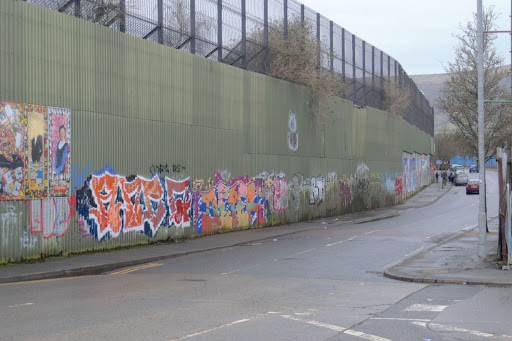
The following day as we were walking between republican and unionist areas, several points of contrast were clear. In the former, art dedicated to anti-imperialist struggles from across the globe. In the latter, printed screens praising the Israeli Occupation Forces and the involvement of unionist paramilitaries in the ethnic cleansing of Palestine. Two starkly different internationalisms. On the unionist side of one of the towering “peace walls”, colourful graffiti and vague messages of peace and coexistence. Passing through two gates to the republican side, a blank wall and additional gratings over backyards to guard against projectiles, some, which never made their mark, seen lodged over ten metres above. A little further on, a memorial to those killed and displaced by the burning of Bombay Street by unionist mobs. Peace for the coloniser means the cessation of resistance. Peace for the colonised means liberation.
On Sunday morning, we arrived in Derry for the annual commemoration of the Bloody Sunday massacre. On that day 14 people were killed and many more injured as British soldiers fired live ammunition into a crowd of civil rights demonstrators, a brutal example of the violence necessary to maintain the British state’s occupation of Ireland. Alongside our comrades in the CYM, we retraced the route taken by those marchers in 1972, eventually arriving at the spot where the killing took place. There was a palpable difference compared to many similar marches in Britain. In place of liberal window dressing and cowardly condemnations of anticolonial resistance there was uncompromising solidarity with the people of Palestine and all those facing imperialist violence. A clear recognition of the absolute inseparability of the struggle against our class enemies on these isles and the defeat of imperialism wherever it sinks its claws into the Earth.
Ultimately, I have come away from the experience with a more visceral understanding of the reactionary nature of the British state and a renewed commitment to the struggle for its overthrow. A blow to the capitalist system that will begin with the liberation of Ireland.
