
Dispatch 1.
Gan Ciaran
“The tradition of all dead generations weighs like a nightmare on the brains of the living. And just as they seem to be occupied with revolutionizing themselves and things, creating something that did not exist before, precisely in such epochs of revolutionary crisis they anxiously conjure up the spirits of the past to their service, borrowing from them names, battle slogans, and costumes in order to present this new scene in world history in time-honored disguise and borrowed language.” – Karl Marx, The 18th Brumaire of Louis Napoleon, (1852), p. 1.
“The Defenders of this Realm have worked well in secret and in the open. They think that they have pacified Ireland. They think that they have purchased half of us and intimidated the other half. They think that they have foreseen everything, think that they have provided against everything; but the fools, the fools, the fools!– they have left us our Fenian dead; and while Ireland holds these graves, Ireland unfree shall never be at peace.” – Padraic Pearse, Oration at the Funeral of Jeremiah Donovan O’Rossa, 1 August 1915
Arriving into Belfast International Airport from the mainland of the UK is an exercise in forgetting, reshaping and altering historical memory. Getting off the plane and walking towards the arrivals section of the airport a large sign greets you, telling you to prepare yourself to experience the city’s “Welcoming Atmosphere”. Walking further into the airport you are presented with carefully curated tourist attractions; you can take a walk through St George’s Market, visit Titanic Belfast or even Crumlin Road Gaol (which is now a mix of museum and events space). It isn’t unheard of for a large city to advertise its heritage to tourists, and in an age of social media virality, the tourism industry in Belfast needs to be able to advertise an “authentic” version of Belfast that presents the city’s history and modern amenities in such a way as to spur economic growth via tourism1. Indeed, criticisms of the tourism industry aside, advertising the history and amenities of Belfast is not even necessarily a negative thing, but the choice to advertise certain destinations or attractions is notable because of what is obscured in the process. Belfast being the site of the Titanic’s construction and that shipbuilding is a major part of local heritage, St George’s Market is a nice Victorian street filled with modern amenities and food vendors, and Belfast being home to Victorian prisons such as Crumlin Road Gaol (who was imprisoned here and why is notably absent from the gazetteers of Belfast, but on tourism adverts you can see a man smile as he is placed in stocks) are all true statements about the city, but these advertisements for the city are arranged in such a way that they obscure the other less pleasant and unmarketable histories of the city.
As you leave Belfast International Airport, the bus into the city centre reveals to you the ways in which the colonial violence of the city continues to live and breathe. The bus announces its stops only in English. There is no Irish spoken on the way in or out of the city, which to the observant tourist is strange considering you know you are in the North of the island of Ireland; “where has all of that Irish gone?” you wonder to yourself. When you get into the city centre you arrive at a sleek, marbled and modern bus and train station that befits the second city of the island. The help desk in the middle of the station has “welcome” written in multiple languages, but not Irish (it notably includes “welcome” in Hebrew).
The Friday night I arrived into the city I was picked up by a friend and comrade who drove me to a pub other members of the PGC and the CYM were at, and it is on the journey where I finally began to see some Irish. “Street” is accompanied by its Irish translation Sráid as you drive through some parts of the city, only for you to turn down another street and return to monolingual street names. The Irish-Unionist divide is still alive and well in Belfast despite attempts by tourism boards to obscure it with appeals to the shipwrecks, old streets and haunted prisons of the city’s past. I was later informed that to apply for your street name to be translated to Irish you need 15% of residents to agree to it, and that all applications can be seen by members of the public should they use the Freedom of Information Act, effectively painting a target on any known Republicans living in Unionist areas and terrorising unknown Republicans into silence with the threat of harassment or violence. The Traditional Unionist Voice (TUV) makes a point of this, stating in one article from November that they had FOIA’d applications for dual language street names and were concerned about “unwanted” Irish street signage that “will only alienate residents”2. Concern about community relations is shared both by the TUV and Belfast City Council, the latter of which states that all applications are assessed based on “potential adverse impacts on the grounds of equality of opportunity, good relations and rural needs.” 3
For both mainstream political parties in the North of Ireland and government institutions, there is an emphasis placed on maintaining the peace brought about by the Good Friday Agreement in 1998. With both central government and Unionist parties resisting the spread of Irish however, it is important to ask the question of what peace, and for who? Where we stayed in Belfast, I and a few other comrades were able to see the “peace walls” built to stop intercity violence running through the back gardens of ordinary people. The entire road network of the city is built around maintaining this segregation between communities, with the M2 Motorway dividing Catholic area from Protestant (there is a Catholic primary school near an intersection on the A501 that has reinforced metal plating over its windows, reminding me of the Holy Cross Attacks of 2002). The tourist marketing of the city of Belfast goes hand in hand with the discourses surrounding the peace process, which in 2025 now approaches its 26th year of existence. If Belfast cannot totally forget the memory of the Troubles and the history of British occupation of the island of Ireland, then it can certainly attempt to obscure it by relegating the segregation of the city to a fact of life and emphasizing the more palatable history of the city to foreign visitors, encapsulated by new developments in the city’s heritage industry that highlight spectres and phantoms from Belfast’s past, all of which are an effort to depoliticise the very recent history of colonial occupation and violence that saturates the city.
On a walking tour provided to us by a member of the CYM, we were given a view of the many Republican murals throughout the city, showing the solidarity Irish republicans have historical expressed with other nations and their anti-imperialist struggles, ranging from Palestine, Cuba, Kurdistan and the Tamils of Sri Lanka. We were told on this walking tour that one strategy of the British army was to arrive in an area and paint a mural that was totally devoid of any political meaning, maintaining the stasis Northern Irish politics finds itself in and filtering all political activity back into the electoralism of Stormont. Further on during the walking tour, we visited the Divis Road International Wall, the Catholic murals demonstrating wide-ranging internationalist solidarity, from Palestine to Cuba and please for political prisoners the world over. We briefly crossed into a Loyalist area to see their side of the international wall, the most stunning part of which was a multi-wall mural dedicated to the Israeli military. What separates these murals from their Republican counterpart is a “peace gate”, locked at 7pm, that party and city authorities would have you believe is just a normal fact of life in Belfast. The contradictions between international solidarity, British occupation and Loyalist support for historic apartheids in South Africa, Rhodesia and currently Israel are all flattened into a single historical epoch that we are to draw no conclusions from other than said epoch was bad, there was “violence” (who started it?) and that we have peace now so we can move on as one big civic community, advertising “our” civic history to tourists who want to come to Belfast for a good time. The pursuit of peace, good community relations, or whatever phrase authorities use to describe the process of forgetting the Troubles and their causes are discursive and ideological weapons one can use against those who address the fact that Ireland is still occupied by the British state. I quoted Padraic Pearse’s famous “Ireland unfree shall never be at peace” at the start of this precisely because of the truth of what it is saying. It is not idle politicking by a nationalist figure, it is not a threat to British authorities, it is simply a statement of fact that as long as Ireland is not one united nation free from the shackles of imperialism, then there never can be peace in Ireland, regardless of how much hand wringing and gnashing of teeth this fact brings with it.
On walking out of the Loyalist area I stopped briefly to take a photo of a peace wall separating the Republican and Loyalist communities. The Loyalist side is covered with graffiti, Bible quotes and slogans along the lines of “give peace a chance” and murals dedicated to Trade Unionists from the area. To this part of Belfast, these walls are simply the price they have to pay for peace in their city, and although an eyesore, are canvasses the Unionists of Belfast use to express their vision of the world, only a five minute walk from the mural to the Israeli occupation forces.

The other side of this peace wall is Bombay Street, burnt down in the summer of 1969 by Loyalist forces. Here we were taken to a mural dedicated to the Clonard Martyrs, where those as young as 15 were killed defending their community from Loyalist attacks. Unlike on the Unionist side, there are no pieces of art, graffiti, or slogans dedicated to peace here, instead there is only a garden dedicated to the Martyrs of Bombay Street telling visitors to “never forget” the massacre that took place. For Irish communities on this side of the wall, the wall is a permanent reminder that, as Pearse said, Ireland unfree shall never be at peace, and is a symbol of their occupation. Any appeals to peace from the Loyalist side of this part of Belfast are only surface level, as any attempt by Irish language activists or republican politics are treated as threats to the peace process that, by its very nature, favours the current status quo favouring the Unionist side. Attempts to even move slightly towards equality by putting Irish back into public spaces are met with derision, as to do so might upset Loyalist communities, and we simply can’t have that because Belfast is now past the Troubles. It is an unending cycle of obscuration and purposeful forgetting of how the conflict came about that ensures the permanent rule of the colonial occupiers.

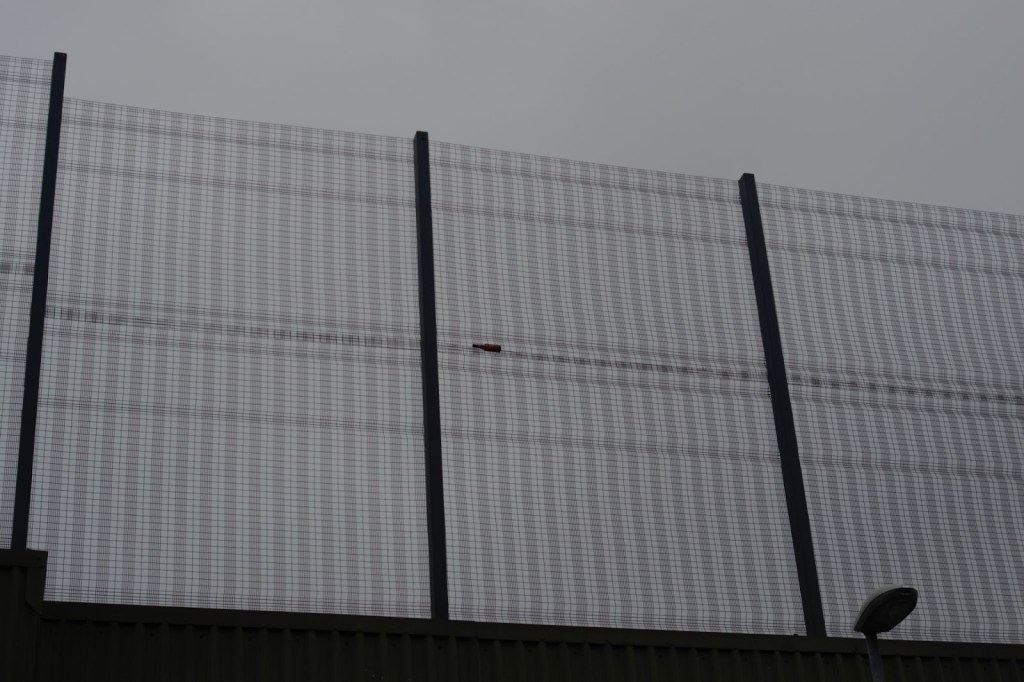
I did not take any photos of this side of the peace wall other than one which shows that someone had thrown a bottle over which was caught, suspended in between the wire mesh of the wall. To me this encapsulates the legacy of the peace process as it approaches its 26th year: the fighting has paused, but the underlying causes and outcomes that stem from the British occupation of Ireland have not been resolved. This bottle could have been thrown from either side of the wall, but it is only on the Bombay Street side of the wall that there are wire mesh covers over people’s gardens. The reader can deduce which side was more likely to have thrown it and whether or not they think the peace process has worked.
The PGC did not come to Northern Ireland for sightseeing however. We were invited to attend a memorial march dedicated to the 14 killed by British forces on 30 January 1972, known better as Bloody Sunday. There is little here I could write here that has not been written better elsewhere, other than to say that the massacre was the result of the occupation of Ireland by the British state and that the British state has no intention of punishing those who committed it, nor giving reparations to the individuals and families whose lives were cut short, whether dying on the day or dying months or years later.
Despite the compradorism of the modern Sinn Fein party and attempts by government and tourism agencies to distil the history of the Troubles into a brief period in Northern Irish history that obscures and flattens all histories of the conflict into one single epoch that revolves around the idea that violence, of any kind, is bad, the sheer mass of people from all sides and ages of the Republican movement in Ireland, of which we in the PGC are very grateful to have been included in, is testimony that the project of forgetting and replacing the history of colonial violence and occupation in Ireland with depoliticised, easily marketable and consumable historical artefacts and exhibitions for a tourist market that wants to have a good time in Northern Ireland is one that is unsuccessful. Despite the parties of Stormont, the central British government in Westminster and private tourism agencies colluding together to try and cultivate a narrative of occupied Ireland that mutates into a vulgar “both-sidesism” that wields the peace process as a cudgel against those who protest the willing forgetting of Irish occupation by the British state, the continued fight for a united Ireland free from British imperialism still continues. Just as Belfast advertises itself as a chic, modern and historic city with many different attractions that it conjures out of its past (viz. the Titanic, the old markets of St George’s Street in their Victorian buildings, or the prisons-turned-wedding venues), so too are the ghosts of Irish resistance animated by those in the present still remembering the injustices inflicted upon them and the desire to right those historic wrongs. I end this by drawing upon the Marx quote from the beginning of this essay, as there are few places anywhere in the world that continue to be haunted by the dead generations of the past than Northern Ireland. Just as the Irish revolutionaries saw themselves as the inheritors of an unbroken legacy of colonial resistance dating back to the 12th century, all of those who attended the march at Derry, whether in person or in spirit, can include themselves in the ranks of those who fought for an end to the British occupation of Ireland. The only task that remains now is to achieve that goal.
