On developing and maintaining long term community action
Gan Y Golygydd YSG
The Cefn Fforest Miners’ Institute, or ‘The Stute’, was a hall built from the wages of the working class, by the hands of the working class, and owned by the working class – by the trade union. It was opened in 1932, as a place for the working class to gather, socialise, learn and study, part of a network of South Wales Miners’ Libraries that taught everything from maths and literacy to Marx and Lenin. It was a place of music, sport, education, socialising, it was the core of the social structure of the community.
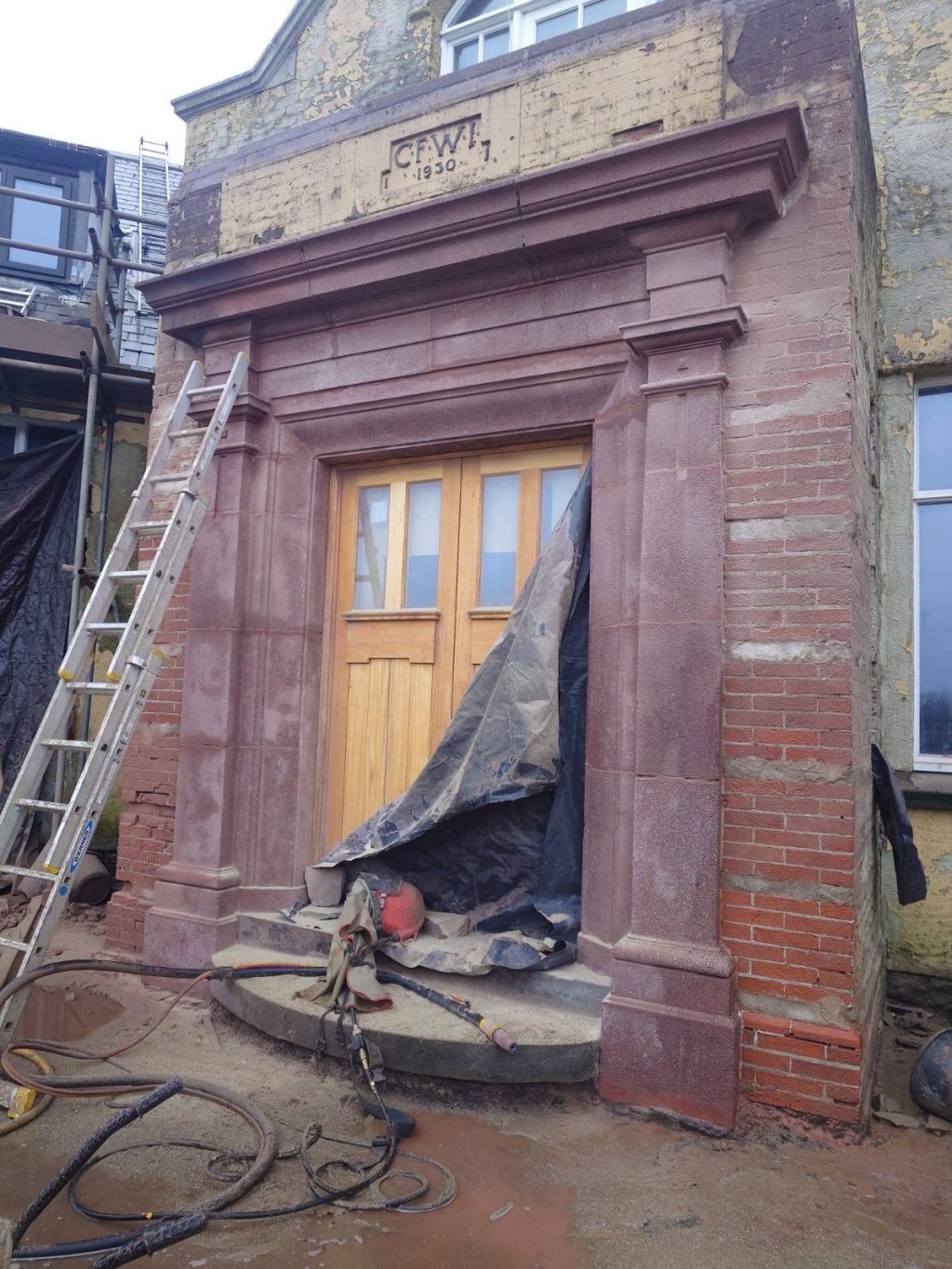
This is all in the past tense for a reason, at the moment it is a seemingly derelict building, with windows boarded over, bricked up doorways and a leaking roof- the building was shuttered in 2012 and left to rot along with the rest of our culture.

But it is only seemingly derelict, inside there are flurries of action. Floorboards are ripped up and replaced, new toilets go in, and the holes in the roof disappear, but who is doing this and why?

In 2019, the Welsh Underground Network (WUN) formed as a rejection of neoliberal decay and deterioration, it is no coincidence that in the same year, the ‘Friends of Cefn Fforest Stute’ was set up.
‘The Stute’ is owned by the community and run by a small committee, Friends of Cefn Fforest Stute, who saved it after years of neglect. The initial campaigning to get it into community hands was fierce but after the win the years dragged on and the momentum was lost. The victory of ownership then changed as they saw the scale of the restoration, rotten floorboards, peeling walls, a defunct roof, broken plumbing and no power. There are big jobs, the roof needs fixing, the plumbing needs replacing, and the building needs rewiring, all jobs that need a specialist to do them. Then there are a million small jobs, dirty jobs, like breaking up concrete, knocking down walls, stripping paint and clearing out rubbish, jobs that anyone with some spare time and energy can do. The committee does an incredible job of getting grants and organising the “big” work with contractors, but when it came to regular necessary work it ended up on the shoulders of only a couple of people.
This is where the WUN comes in. 100 years ago, workers got their hands dirty to build ‘The Stute’, so why shouldn’t we get ours dirty to rebuild it? Once a month, sometimes every week, we send in a crew, a group of dedicated comrades, to do the jobs that would cost a fortune to hire in for. We have been doing this for a very long time.

Breaking the Pattern
We are often asked about how we maintain energy and what keeps us turning up year after year. When we look to other community “save our XYZ”-type projects, we see big campaigns that land with a splash, raise loads of cash, achieve the initial goal, buy the building and then what?
We’ve all seen this scenario – a local community institute is in danger of being torn down, turned into a car park, luxury flats, maybe the land will be sold on between different developers whilst they get planning permission for the next abomination. A local campaign begins and rallies the community to save the building, maybe the local branches of different socialist parties and organisations get involved and make placards (and certainly sell a few papers whilst they’re at it!). Maybe they’re successful and save it! It now passes into the stewardship of the local community.
What happens next? The energy dies down, and people move on, those left behind become overwhelmed by the amount of work to do and they struggle to revitalise it as a community project. A few years pass, and the community institute has fallen into such a deep state of disrepair that there is simply nothing left to do but let it go. Back to square one – and now less energy to save it, because what are we saving?
A Kurdish Women’s Group pamphlet describes their comrades’ surprise at the campaign-based organising in the West and the need for a sustained commitment to revolutionary life rather than one-off actions.
“A striking reality that became obvious in the experiences of many comrades participating in the education was the lack of continuity of non-system movements and activism in the West.
For example, if there is an action, everyone participates in that action or for a certain time in a campaign, but after that everyone returns to their own ‘private’ lives. There is no continuity of revolutionary life that is reflected in every moment of life.”
Well, the WUN has always done things differently. We got involved after a local member stumbled upon ‘The Stute’ and got in contact with the committee who were running it. We started with a couple of volunteers popping down on weekends to help with tasks the trustees and committee couldn’t do themselves. We’ve been doing this for 3 years now, and the WUN has grown considerably. One or two dedicated members going to ‘The Stute’ has turned into a whole brigade of communists, all coming from across the Valleys to Cefn Fforest.
Dirty Hands & A Red Flag
The WUN was founded on a frustration with the status quo of socialist organising in Wales. We were angry at how socialists, nationalists, would sit in circles and talk, but never get their hands dirty. Not us, we talk, sure, but we do it with dirty hands, alongside anyone who wants to help. The first members of WUN all came from proper working-class Valleys towns and they have all seen them decay, whilst money is pumped into luxury developments, politicians’ pockets and endless Welsh Government reviews which identify problems but never fix them. Look to Merthyr Tydfil for harrowing examples of this pattern. This feeling of abandonment and powerlessness drives a person to revolutionary action.
Our members took control of what they could – the community. Our approach is not to focus on a single campaign and then move on, it is to acknowledge and understand that we are part of the community, and when we commit to something, we stay committed. We are committed to a better world, so we must be committed to a better Wales, a better Valleys, a better town, a better village, a better ‘Stute’!
Our members are from all walks of life but have built their own connection to ‘The Stute’ through their work there. We have become committed to seeing it through and getting it back in the hands of the community. We are all looking forward to the day when the doors will open back up to locals and it will fulfil the function that the miners wanted, once again (although this time we’d like women to be allowed in the library!). Education, socialising, parties and more should be held in the Stute. It was built with money from miners’ wages and will be returned to the children and grandchildren of those miners, along with any newer arrivals in Cefn Fforest.
Momentum
I asked WUN members why they work at the Stute and whether they would have got involved without the WUN. Most said that even if they were likely to have helped out as an individual, being part of an organised group motivated them to attend Stute days and they look forward to coming to the Stute to see their friends and comrades. Arriving as a large group, being given one task and leaving when the task is done is more powerful than attending sporadically as individuals. The feeling of coming together as a team and achieving something was important to them all.
The physical nature of the work was also a talking point! Though the work is often dirty and strenuous, it is far more rewarding than going to the gym or answering emails for a big company. The disgusting nature of stripping paint off the walls or smashing dirty old tiles off the walls of a toilet is kind of appealing to our members, it’s cathartic, therapeutic… a different experience harkening back to a manual history that many of us are detached from. ‘Manual labour’ no longer makes up the majority of working-class jobs, we deform our backs over the desk or checkout till rather than break them in mines and quarries!

The ideological underpinning that the WUN gives was also important, most members talked about their connection to local history, their rage at communities left behind and their urge to “do something, anything!”. ‘The Stute’ is emblematic of a diminishing culture of the working class Valleys, the culture of community, ownership, solidarity and collectivism. Our work in ‘The Stute’ connects us to the same workers who built it, our hands are dirty in the same mud, and it is a continuation of this direct action in a new chapter in the history of Wales.
The WUN also gives an organisational boost, we have a couple of key contacts who talk to the Stute committee and arrange tasks for each day. This saves time for the Stute committee and helps organise our members. Leadership in this is vital, and the WUN is lucky to have many skilled and dedicated members who can take the lead on projects like this.
Throughout our conversations a deep feeling became apparent, a dedication and commitment that goes beyond party line and becomes love. Love of the work, love of the people and love of the Stute. So to close this article let’s refer to Alexandra Kollontai, writing a letter to the working youth in 1923:
“For a social system to be built on solidarity and co-operation it is essential that people should be capable of love and warm emotions. The proletarian ideology, therefore, attempts to educate and encourage every member of the working class to be capable of responding to the distress and needs of other members of the class, of a sensitive understanding of others and a penetrating consciousness of the individual’s relationship to the collective.
All these “warm emotions” – sensitivity, compassion, sympathy and responsiveness – derive from one source: they are aspects of love, not in the narrow, sexual sense but in the broad meaning of the word. Love is an emotion that unites and is consequently of an organising character.”
We love ‘The Stute’, we love our working-class culture, we love our towns, faded as they may be, we love our comrades and we love the Welsh Underground Network. For a better Wales, for a socialist Wales, for the Socialist Republic of Wales – it has to be done with love.
