
By Gruff
In 1674 Captain Harri Morgan was released from house arrest in London. He had been held for two years while the royal court examined his eleven years at sea. A career which had seen Panama City, the most populous in the Spanish Empire, burned to the ground alongside multiple massacres and the enthusiastic embrace of torture. For his sins Captain Morgan was knighted. As he returned to polite society, the Welshman, now styled as The Second Francis Drake, was inundated with English praise. Born to farmers in Llanrumney he had now entered the highest echelons of British society. Within months of his release he would return to Jamaica, living out the rest of his life as a colonial governor and plantation baron. More so than any other person of this era, he represented the opportunity afforded to the white middle-class in the early days of the British Empire. An arch-imperialist and early capitalist who achieved a level of wealth and power previously impossible to a man of his station.
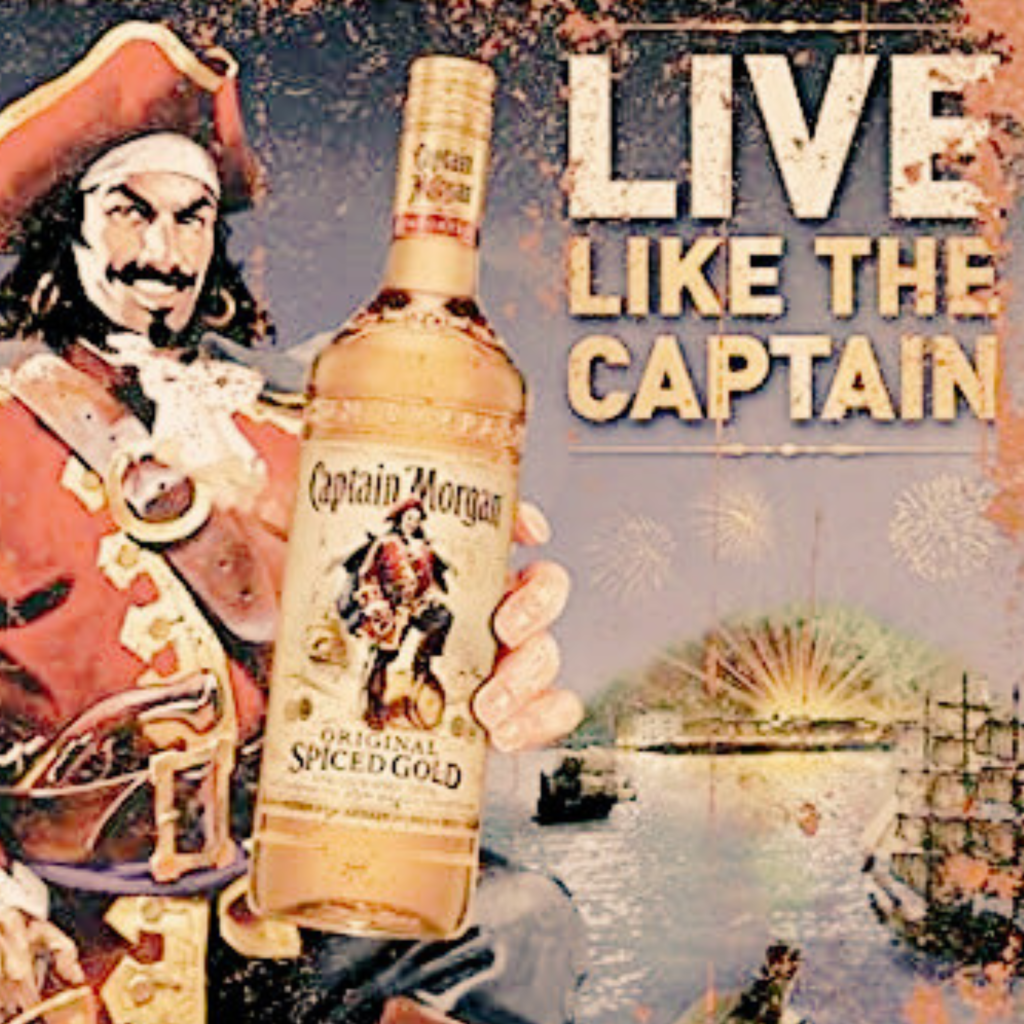
So, who was the man who now lines the shelves of every offlicence from Cardiff to Mexico City? And how does one begin to separate him from the product that has so utterly eclipsed him? The two are inextricably and intentionally linked, indeed a search for “Captain Morgan Controversy” leads to a 2014 banned advertisement. In the 30 second TV spot Captain Morgan swaggers through the Caribbean to Kasabian’s Club Foot, while a narrator encourages us to live like the captain. The controversy stemmed not from the historical implications of such a statement, but because it encouraged reckless drinking. In reality, any attempt to search for the historical Captain Morgan requires endless specification as a means of avoiding the corporate brand. So today let’s set the record straight.
By the mid 17th century the British Empire had begun in earnest, and from its earliest days it had been a fountain of bourgeoisie advancement. John Hawkins, inventor of the triangle trade, and arguably Britain’s first imperialist, had come from a solidly middle class family. His cousin and fellow slave trader, Francis Drake, would go on to prove the effectiveness of privateers as an imperial weapon, challenging, for the first time, Spanish hegemony over the American continent. Both were knighted. Thrilled by the opportunity to bypass Britain’s aristocratic monopoly, Hawkins and Drake’s class compatriots would pioneer the use of shareholder companies for high profit extractivism. The advent of these modern capitalists would not only shape the emerging British Empire but dramatically shift the political structure of the homeland itself. One stunning example is the Providence Island Company, established 1629, which led a military campaign to impose a Puritan slave colony and pirate base on the island of Providencia (modern day Colombia). Of its twenty shareholders, nine would play essential roles in establishing and leading the first Parliamentary army during the English Civil War, and with that bourgeoisie revolution complete in 1651, their leader Oliver Cromwell placed colonial expansion at the top of his list. The Western Design, launched in 1654 would see Britain spend six years at war in the Caribbean, ultimately prising Jamaica out of Spanish hands.
It is likely that Captain Morgan first arrived in the Caribbean as a part of this war, though the date and circumstances of his arrival remain obscure. While he was loosely related to the aristocratic Morgans of Tredegar, alongside practically every South Walian, Captain Morgan’s family were middle class farmers from what was then the town of Llanrumney. Like thousands of other bourgeois Brits he saw a chance to seize power and wealth far from the closed aristocracy of England. He quickly rose through the ranks of royally commissioned privateers in the Caribbean front. He came to be a close friend of the governor of Jamaica, Thomas Modyford, who had been charged with protecting the far-off island however he could. By 1668, Morgan’s merit as a commander had made him admiral of his own private fleet, sailing under the full protection of the colonial government. His career as a pirate, would reach its zenith in 1671 as Morgan crossed Panama at the head of a 1,400 man army, before burning its capital to the ground. Ever the capitalist, Captain Morgan then hoarded the wealth of Spain’s richest province, returning to Jamaica as a hero, while his soldiers and crewmen languished in poverty. Unfortunately for Morgan, this Panama attack had taken place just one month after the conclusion of a peace treaty between England and Spain. As a result, both Morgan and his right hand man Modyford, were chained and sent to London to face trail.
We know these details because of an account published by the Surgeon who served on Morgan’s flagship, Alexandre Exquemelin. In his book, published 1684, Exquemelin paints an image of a highly skilled naval and military commander at the head of an unhinged campaign of violence. In his raid on Puerto Principe, now Camagüey in Cuba, Morgan had the townspeople locked in a church and starved until they revealed the whereabouts of hidden stashes of treasure. During his assault on the fort of Porto Bello, Panama, Morgan gathered catholic priests and a convent of nuns and used them as human shields. While over the course of his 3 week occupation of the Venezuelan town of Mairacobo, Morgan used the rack and burning palm leaves on 100 families, before finally binding their heads and tightening the cords until their eyes burst from their sockets. All of this and more was done in the name of personal wealth and securing British colonial interests. This account, widely published in English, horrified its British audience. Morgan sued Exquemelin’s English publisher for libel. The publisher promptly agreed to remove the references to Morgan’s human shields but all the other crimes remained in subsequent reprints. To this day however, most historical articles dismiss these crimes on the grounds Morgan denied them, or give the caveat that Morgan’s crimes are contested, neglecting to mention that no crew members or officers ever contested Exquemelin’s book, which had had four reprints during Morgan’s lifetime.
In modern storytelling we like our pirates innocent – From Captain Morgan’s Spiced to Barti Ddu Rum or Jack Sparrow and Taika Waititi’s Black Beard – proto-anarchists at the helm of floating mini democracies, ignorant of the prejudices that defined their age. Captain Morgan was none of these things. Piracy, Slavery, Imperialism. These are three words that in the modern day imagination have been inextricably separated. Yet in reality they are three sides of a single prism. Captain Morgan worked hand in glove with the colonial governor Modyford throughout his time at sea. A relationship that even saw Morgan gifted the Royal Navy’s HMS Oxford to be used as a personal flagship. While the next phase of Morgan’s life would see him become fully entrenched in the colonial plantation system, it was a relationship that had begun long before.
In 1666, two years before achieving the status of admiral, Morgan married his cousin Mary, the daughter of Jamaica’s Deputy Governor, and received a slave plantation as a part of her dowry. By the end of his life Morgan would lay claim to three plantations, with 131 Africans as his personal property. As a part of the rule of threes he would, in Jamaica, lead three military campaigns into the Blue Mountains in an attempt to capture and execute the self liberated slave Juan de Serras, who commanded a guerilla war from 1655 to 1670 against, not only British colonists but the institution of slavery itself, attacking plantations and their owners. While Morgan failed in his stated objective, he was apparently successful in forcing Juan de Serras’ army of freed slaves far enough into the mountains that the conflict ceased.
In politics, Morgan came across as pitiable. His first task as a member of Jamaica’s assembly was, ironically, to put an end to the use of the island as a pirate base. A responsibility he immediately turned into a protection racket. As an untouchable figure he would repeatedly clash with Jamaica’s next governor, the Earl of Carbery, who had taken over from Modyford. Carbery saw Morgan for exactly what he was, a drunk with an enormous ego and moved to have him recalled back to Britain. In late 1677 Carbery instead was ordered home, leaving Morgan as de facto governor. Under Morgan, Jamaica’s government came to be defined by martial law, corruption and factionalism, until a permanent replacement finally arrived in 1687. Morgan, an alcoholic gambler, who had been rampantly incompetent as a politician was rubber-stamped as a government “advisor”, a position he held until his death in 1688 aged 53.
Morgan was undoubtedly the most successful pirate to have come out of the age of piracy. Unique in his ability to achieve political power and prestige following a career at sea. This success did not make him an outlier however, neither as a Welshman nor a privateer.
Those who were involved in the Welsh branch of the Black Lives Matter movement will remember the campaign to take down the statue of Thomas Picton, the Tyrant of Trinidad, who would serve as a Caribbean governor roughly a century after Morgan’s death. And the Welsh were not only confined to the Caribbean. The “explorer” Henry Morton Stanley, who established the Congo Free State on behalf of King Leopold II of Belgium was born in Denbighshire. In piracy, Barti Ddu from Casnewydd Bach, who wrote the Pirate Code and invented the Jolly Roger, first entered the historical record as a second mate on a slave transport called the Princess.
Captain Morgan then was not a historical curiosity, but a pioneer, who blazed an aspirational path that would come to be well trodden by his Welsh countrymen. The lesson of his legacy is what we allow to be lost, and more importantly what Britain celebrates, when we continue to see the heroes of the British Empire as heroes, free from their imperial context.So when Captain Morgan Rum encourages us to “live like the captain” we can never forget the world that we are currently living in, his.
