
An article reposted from Forward, the Connolly Youth Movement’s paper
Introduction from Y Seren Goch
Today marks the beginning of the National Eisteddfod, the largest poetry and art festival in Europe, which cherishes the Welsh language and bardic culture. We wanted to raise the question of how best do we fight for the Welsh language? How can the fight for the Welsh language become part of a practical doctrine that can be applied to minoritised languages across the world?
Our comrades in Ireland, in the Connolly Youth Movement, have also been examining this question over the years, and published an article in Forward about the revolutionary aspect of the language struggle, and have given us permission to reshare it here with our thoughts on the Welsh language struggle.
“Support for the language emerges from below, in much the same way as support for the revolution.”
The Welsh Context
Plaid Gomiwnyddol Cymru, the Communist Party of Wales, have been hard at work recently on their upcoming piece of work, a truly Marxist understanding of where Wales is today, where we have come from and why we are at this point. A section of this is wholly dedicated to the language struggle, to the place of language in society today, and the tactics used in the past to bring an end to the deterioration of the language. But why do we fight for the Welsh language?
“We are not in favour of revitalising Cymraeg as the national language of Wales out of abstract affection for the language, but as a revolutionary strategy to decouple from Anglo-American hegemony and build a new society with our own language, an indigenous means of intellectual and community production at its core. In short, language is a tool for the production of knowledge and the coordination of movements.
Our commitment to the re-establishment of Cymraeg as the primary language of Wales stems from our commitment to Welsh sovereignty; economic, political and intellectual.” – excerpt from ‘The National Language’, soon to be released
Right now, the Welsh language sits at 530,000 speakers, it is at this point relatively stable, but stability does not mean advancement. What tools and tactics do we have at our disposal? We seek to not only learn from the Welsh language activists who have fought long and hard to get to where we are today, but we want to learn about the fight of minoritised language everywhere.
We have begun establishing good relations with comrades in Ireland, in Scotland, in Cornwall, in Breton, where we share the common language root and have strong historic links, but we also want to look beyond this. We want to establish links with groups fighting for their national language against English and French linguistic dominance in Africa, indigenous languages in America, both South and in the North, and the Sámi languages across the Scandinavian countries. This is not an exhaustive list, but the struggle would be deeply limited if we did not look outside of our own borders and to our immediate neighbours for inspiration here.
“On review, Cymraeg can be said to firmly exist in the category of a second-class language. Provided lukewarm support in the public sphere, and left to the will of the market in the private sphere, Cymraeg sits uneasily in a position shared by many minoritised languages; afforded just enough support to preserve it, but in a state of living death, worthy of a place in a museum exhibit, but left to die in the realm of public life where English is definitively the primary language with rare exception.” – excerpt from ‘The National Language’, soon to be released
Cymrucisation
Our first step is a small but vital one – the Cymrucisation of our party. This is an active policy which looks at all official bodies, roles, titles, and applies the Cymraeg name over the English one. This stems from the idea of normalising using Cymraeg internally, in a way which feels eventually natural and every day, however it has to be active in that it requires all members to be open to being corrected themselves, and able to correct others. Beyond the language, this reinforces an atmosphere where people feel able to discuss, debate and be corrected without causing interpersonal conflict.
You can see this policy in our name, we seek to be known as Plaid Gomiwnyddol Cymru first and foremost, with the Communist Party of Wales coming second. In our international work, we have seen other Communist Parties use Cymraeg in their conversations with us, both echoing our use of certain phrases (we sign off all emails with “mewn undod” which is often reciprocated), and the use of new bits of Welsh which they would have found through searching for it. So whilst this policy is a very small one, it both reinforces the use of Welsh internally, and introduces the language struggle as a core part of our platform to our international comrades.
We invite you all to read the fantastic article written by our comrades, and think about how we can advance the struggle in Wales for the language.
A Protracted Struggle for Minoritised Languages
April 26, 2022 by CYM Committee
OAP, Béal Feirste
A language revival has a lot of similarities with a revolutionary movement.
Just as a revolutionary movement must have its beginnings in particular communities and be built outwards, minoritised languages need to take root in particular communities first and then expand.
Why is this? A language that has no community usage is an academic pursuit, as much a part of the life of working people as Latin. For a language to re-emerge, to be used daily by the entire nation, it must first be used daily by one household, one street, one place of work. A language must take root, develop within a community and become indispensable to its people. It would not be possible for a vanguard party to seize state power without the support of the people, support that is developed through protracted struggle. In the same way, it would not be possible for a language to become the primary language of the nation without first being developed as the language of communities across the nation. Support for the language emerges from below, in much the same way as support for the revolution.
Just as revolutionary movements must become, for the working people of the communities they grow in, a more legitimate form of government than the capitalist state, minoritised languages must become, for the working people of the communities they grow in, a more legitimate form of communication than that of the language forced upon the nation by imperialism.
Why is this? A language that is widespread, but secondary in importance to the imperialist majority language, will naturally only be used as a secondary language. The minoritised language will be used perhaps in the household, perhaps in cultural events, but the imperialist majority language will still be the language of politics, commerce, business, national communications. In much the same way that a revolutionary movement that is widespread, but seen as secondary to the state, will be seen as a charitable organisation at best, and at worst crushed by the capitalist state, a minoritised language that remains secondary to the imperialist majority language will be seen as a cultural oddity at best, and at worst condemned to extinction.
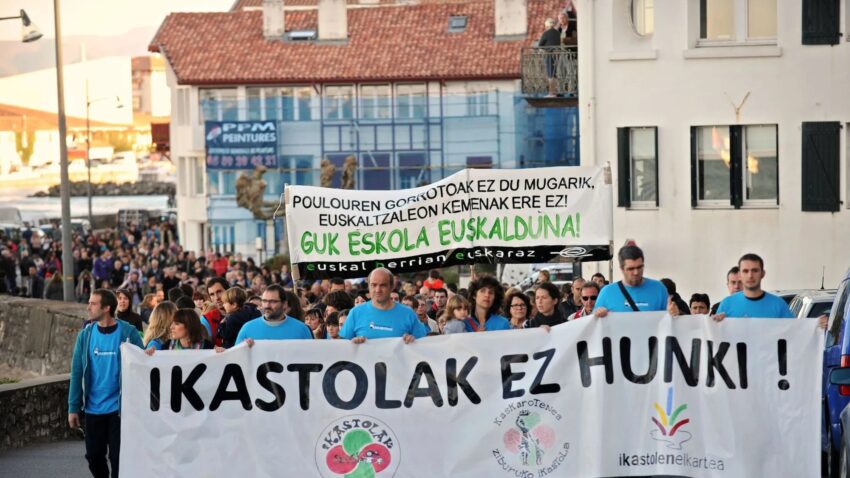
Just as a revolutionary movement cannot grow without the active work of a vanguard party, a language revival cannot happen spontaneously.
Why is this? A language revival requires constant diligent work from activists to ensure that the language is protected, used, and promoted within a community. A revolutionary movement, without the guidance of a vanguard party, will splinter, peter out, and disintegrate. Similarly, language revival, without constant work will become a hobby for a handful of those interested in cultural preservation and will ultimately fall by the wayside. Only a well-organised campaign can successfully begin to grow a linguistic community. Only when activists are holding public free study sessions, demanding public areas include minoritised language signage, speaking and writing publicly in the minoritised language will that language begin to become the community language.
Just as a revolutionary movement cannot stagnate and must be in constant struggle with the capitalist state in order to succeed, a language revival too cannot stagnate, and must constantly be growing in order to succeed.
Why is this? A language movement that is confined to a specific geographic area with no hopes of expansion is a language movement that is accepting its own demise. A language movement that confines itself to a specific region in the hope that this will be enough to preserve the language will see that those people who speak the minoritised language and the imperialist majority language will leave for areas in which the imperialist majority language is spoken, as jobs will be more abundant and wages will be higher in these areas. Just as a revolutionary movement in the stage of protracted peoples war must be in constant struggle with the capitalist state in order to have hopes of success, the language revival movement must attempt to constantly expand into new communities, building deep roots within them and ensuring the language becomes the primary language of those communities too, before moving on to expand into new areas. A stagnant language movement confined to one area of the linguistic nation will always be in competition with imperialist majority language speaking areas and will compare unfavourably in employment and wages. An active language movement, in constant struggle to expand into new regions, will only be in competition with those who actively resist the expansion of the minority language. Comparison of wages or employment will be less of a problem, because the areas with high wages and high employment will soon also be a community where the primary language is the minoritised language.
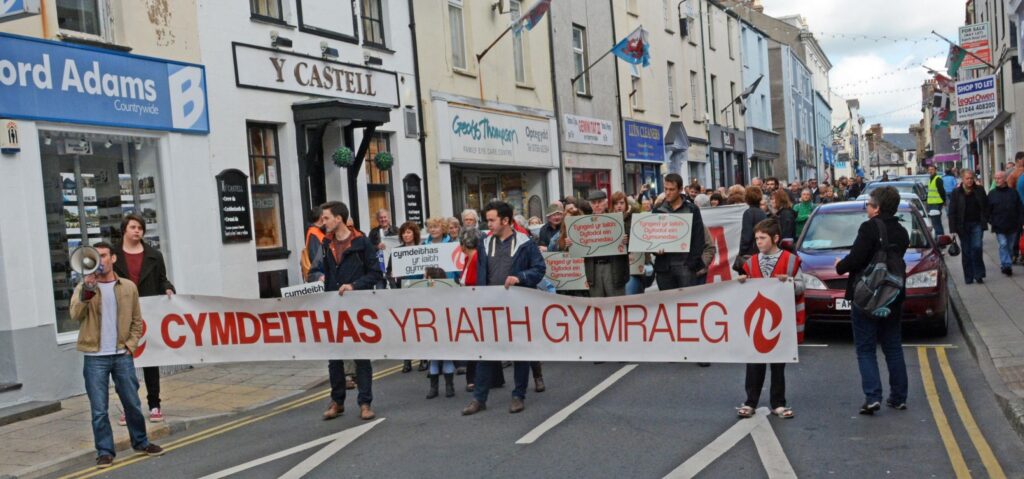
Just as an understanding of Marxism-Leninism by the individuals within the revolutionary vanguard is a necessity for the success of the revolutionary struggle on a national scale, an understanding of the minoritised language and its political importance within the revolutionary vanguard is a necessity for the success of the language revival on a national scale.
Why is this? A revolutionary movement must be driven by a vanguard party with a proper understanding of Marxism-Leninism, or else will suffer the same pitfalls as historic revolutionary movements that did not learn from previous struggles. In much the same way, the language revival movement must be imbued with an understanding of the functions of the minoritised language, its history and the reason for the importance of its study. Any revolutionary vanguard that does not study Marxism-Leninism will be condemning themselves to an ideological dead end, strategic mistakes, and in all likelihood failure. Similarly, any language revival movement that does not study the language, its history and its political importance will condemning themselves to this same failure.
The similarities in the way we construct revolutionary movements and language revivals is not coincidental. Both are community lead, anti-imperialist movements. Both require broad public participation. Both are the cause and duty of communists in the peripheral, imperialised nations of the world. When done correctly, both a revolutionary movement and a language revival movement should be anti-imperialist, anti-capitalist, and conducted in tandem. This is true of our Irish context and is equally true for revolutionary movements around the world that base themselves within nations whose indigenous languages have been minoritised.
Read the original article, and many others from our comrades – here
