
This year we look back on Welsh socialist women and their involvement in the socialist struggle in our country.
Women are central to the struggle for socialism; the struggle for peace, for health, for education, for a better life entirely. In 2023, to celebrate the working class history of Wales, the Welsh Underground Network published a timeline of how International Women’s Day (IWD) came into existence – it was created by socialist women, cemented in history through the Russian Revolution – the capitalist world took decades to recognise International Women’s Day.
As Mao Zedong said, “Women hold up half the sky”, and in Wales, we are no different, women hold up half the sky and half the mountains! From the very beginning of the communist movement in Wales, in the wake of the 1917 revolution, the foundation of the Communist Party of Great Britain, the 1984 Miners’ Strike, to today, women are pushing the movement on and making it stronger.
The Miners’ Strike of 1984-85
Particularly topical, as we enter the 40th anniversary year of the strike, we must begin by paying tribute to all the women who were involved in the Miners’ Strike of ‘84. Women in the Welsh coalfields were major players in the resistance to Thatcher and the Coal Board cuts. History, often written by men, tends towards patronising and minimising women as historical figures. We know that women in the coalfields did not simply “passively support” their husbands. They fought for their husbands, sons, brothers, uncles, and for themselves, because they knew that “to close a pit is to kill a community”.
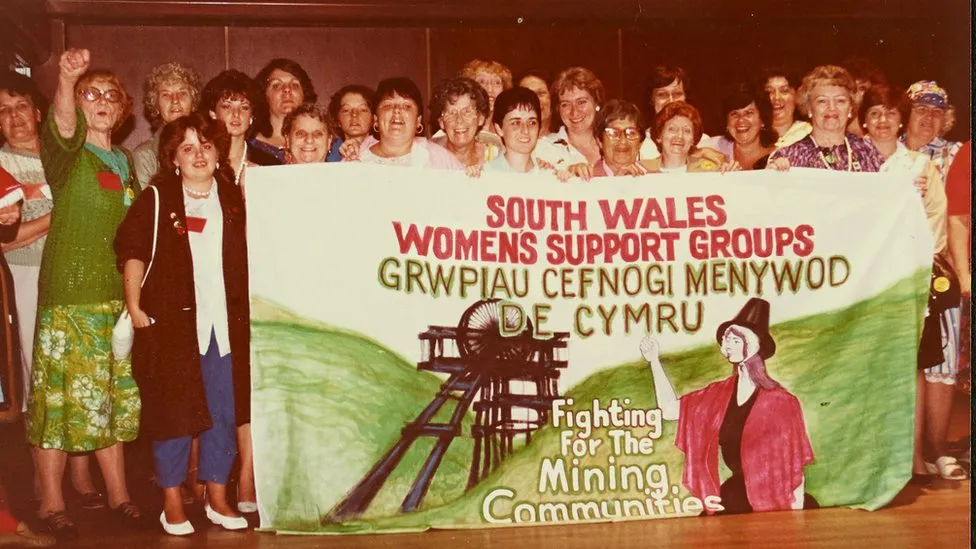
As the fight for the pits quickly became an all out fight not just for jobs and wages, but the protection of working class communities in Wales, women became leaders of the movement – forming Women Against Pit Closures (WAPC) and other support groups. While men were on pickets, women were out campaigning to drum up support for the miners not just in Wales, but internationally: “here, there and everywhere” as Sian James said, a WAPC organiser pictured below holding up the left corner of the banner.

Image from the Glamorgan Archives.
Many Welsh women cut their teeth in political campaigning through the strike, perhaps the most famous is Sian James. Readers who have watched the film Pride will remember Sian leading the mining community of Onllwyn towards accepting LGSM (Lesbians and Gays Support the Miners) and their help. During the strike she helped feed over 1000 families via centres across 3 different valleys. After the strike she got an education, went to university and eventually became the first woman to be MP for Swansea East in 2005.
Of course nothing is ever simple, and Wales has never been perfect, many women faced misogyny from miners and people in positions of power. Many juggled childcare and men-care, managing depleted household budgets while keeping kids happy and men away from the beer. The image of a Welsh Mam, backbone of her family, holding the purse strings is an echo of the past which started in the early 1900s but held true enough until Thatcher and her cronies began to steal industrial jobs. The strike pushed families hard and scabs often quote their concern for children as pushing them to work. However, the tenacity and determination of Welsh families meant that in some areas such as Penrhiwceibr, not a single person scabbed.
International solidarity helped maintain spirits and health, with trade unions and women’s groups in the Soviet Union sending huge food donations to Wales. Mining families were also invited on a summer holiday to the Soviet Union, the trip was so popular the NUM launched a lottery across Britain to decide who should go. Many other countries sent trucks of aid and clothes.
Whilst many women came into this strike from a political background, there is no doubt that many, many more were deeply politicised by the strike and left it as skilled organisers. Women learnt to speak to crowds of hundreds or thousands of striking miners, their families and supporters. They challenged patriarchal attitudes towards the role of women and combined the liberation of women with the liberation of the working classes.
1984 was not however the start for many women in Wales, with a strong legacy and history of organising in the decades before.
The foundations of communism in Wales
“We had, as socialists, hailed with delight the Russian Revolution of 1917. We had regarded it as the beginning of the triumph of our ideas. But already in 1919 the golden vision had been a little tarnished. Stories came out of Russia which gave rise to doubts, but still we hoped. Sylvia [Pankhurst] had been full of confidence in the revolution, and had gone out to make contact with its leaders. But alas, she had returned disillusioned and sad… but hope springs eternal – we could not so easily discard our faith in the great Russian Revolution, and its implications for the workers of the world.”
Winifred Griffiths, 1919, An excerpt from One Woman’s Story.
In 1919, despite not being able to vote as universal suffrage had not yet been granted to women, Winifred committed to campaigning on behalf of Labour in the Rhondda to persuade those who could vote, to vote for their local Labour candidate. Like the women who understood the societal implications of the closure of pits in 1984, Winifred was politically active inside and outside of elections despite not having the most basic of voting rights as a working-class young woman. She, like millions of working-class people globally, was enthused by the workers’ revolution of 1917, and this faith could not be easily shaken, as she knew that the workers’ revolution was the goal of all workers, worldwide.
The creation of the Communist Party of Great Britain is the result of her faith, and the faith of her fellow workers, in this revolution. From the outset, women in Wales were active alongside men in the fight for the rights of workers and the struggle for socialism. One Elizabeth Andrews, a miner’s wife, wrote to the South Wales Miners Federation (SWMF) to raise the inclusion of mandatory pit baths in their campaign for shorter hours for the miners. She remarked that “women felt that the time was long overdue to get something done to lighten the burden of the miners’ wife”, referring to the fact that a miner’s wife had a full-time job of back-breaking work running the house and setting up the bath every evening. Even if the bath was successful the coal dust filled the house and had to be scrubbed away daily. She reminded the SWMF that the struggle for shorter hours must include women, and women played a key part in the campaign for installing pithead baths at every pit.
In 1927, Winifred was elected Chairman (as she puts it!) of her local Women’s branch of the Labour Party, and became increasingly active politically, organising, standing for elections and campaigning whilst she was pregnant. She writes about her interactions with Communist Party members, and writing for ‘The Social Democrat’ Women’s page. In her personal diaries, she writes
“If I was a dictator I would call a standstill to any increase in the personal incomes of people above a certain level until such a time that all people below that level were brought into line, and I would halt the construction of luxury flats and hotels and of prestige buildings of all kinds, until the homeless and slum dwellings were decently housed. My next priority would be the rebuilding or modernising of out-of-date hospitals and schools. I wish we could wage war on poverty and bad housing with the same urgency and single-mindedness we brought to bear on defeating our enemy in wartime”.
She writes of her idealism, and the dying idealism of the Labour Party as it transforms into just a Party. She writes that politics are not enough, that the hearts and minds must be won too. At the very inception of the organised worker’s movement in Wales, Winifred was there with just as much clarity, if not more, than many people of her day, and most likely ours too.
As we reflect on her words today it seems that changes to policies achieved by women’s campaigns, trade unions and others through the years have failed to address the rot which is at the core of society. Capitalism is the greatest hindrance to progress and reform has not worked, it cannot work.
Today, on International Womens Day 2024, a plaque is going up in Aberdare to celebrate the life of Ceridwen Brown, a communist, an anti-means test campaigner, a hunger marcher, she raised money for the Republican forces in the Spanish Civil War. Across Wales, we need to celebrate the lives of the working-class women who fought for the things we fight for still – an end to war, to poverty, to hunger, to the mistreatment of the working class entirely.
Peace and the fight for Palestine
We’re now 40 years on from the 1984 Miners Strike, and almost 100 years from the 1926 General Strike – the effects of pit closures are felt everywhere and we’re still fighting for the same things as Winifred Griffiths and Elizabeth Andrews were fighting for. The aftermath of World War One, and the creation of the workers movement gave rise to a strong, anti-war movement in Wales. As we write, the zionist entity – “israel” – wages a brutal, genocidal war on the Palestinian people. The people of Wales are on the streets week in, and week out, in solidarity with the Palestinian people’s struggle, how are women today influenced by those that came before us then?
Remembering the example of Pride above, and the beautiful scene where they sing ‘Bread & Roses’, demonstrations in Wales have always involved music and group singing – a collective spirit that acts in solidarity. Côr Cochion, the Red Choir, have been singing at every demonstration, and helped organise a mass 100 person strong choir with Welsh singer Charlotte Church, to sing in solidarity with Palestine and raise money.
The Campaign For Nuclear Disarmament was particularly strong in Wales, with the ‘Women For Life On Earth’ group marching from Cardiff to Greenham Commons in Berkshire, and establishing the Peace Camp at Greenham Commons – which lasted from 1981-2000.
We asked a Welsh woman why she organises for Palestine, and for peace.
As a woman, why are you involved in Palestine solidarity?
“Because, as Pericles said, “just because you do not take an interest in politics doesn’t mean politics won’t take an interest in you”. As I’ve grown older and realised from a relatively privileged upbringing, that being a women, even in “western civilised countries” means you’re inherently disadvantaged. I have realised that my solidarity must extend to women all over the world, at the moment the women in Gaza are suffering extremely unsafe birth conditions, having to look after families with no food, making ovens out of the mud on the ground. All because the zionists have escalated their genocide against all Palestinians.”
Do you feel a connection to the generations of women before you who were politically active?
“I have felt a strong connection with the women of Wales on our marches, particularly those who bring their entire families. To be able to explain to a child the reality of the world without destroying their hope is such a impossible and delicate thing for women to do – but they are doing it, and it is inspirational and brings me hope. I’ve seen Côr Cochion out weekly, and that brings home the rich history of Welsh anti-war organisers, the majority [of the choir] are women now. Perhaps thats a sad reflection on the lifespan of old miners and industrial workers in Wales,the women are left to fight on. Women in Wales have always stood up for their communities, because nothing is isolated to the man as an isolated unit. Looking back to the strikes of 1926 women knew that their men’s fight was their fight. Today we march with generations of Welsh women behind us.”
Here, at Y Seren Goch and the Welsh Underground Network, we honour the working class women of Wales, we honour the centuries of struggle for peace, land and bread, and we hope for the future. The fight continues, it continues through us, through you, through the hundreds and thousands of activists on the street every week. There is a world to win!
